

Booking dry van capacity in California is no longer just a question of rate-per-mile and equipment availability. Under active enforcement from the California Air Resources Board (CARB), freight regulations directly affect hiring entities—including shippers, manufacturers, and freight brokers.
Tendering a load to a non-compliant carrier creates major supply chain disruptions. Trucks lacking active state environmental clearances risk automated gate turnaways at marine terminals, roadside impoundments by the California Highway Patrol, and statutory fines levied against the hiring broker or shipper.
Navigating dryvan regional longhaul in California requires knowing how current emissions regulations work, how to audit your carriers’ equipment status before dispatch, and why partnering with compliant, asset-backed fleets protects your balance sheet.
Active California Trucking Regulations: What Shippers Must Know
California enforces clean-fleet standards through layered regulatory programs. While carriers bear the mechanical burden of upgrading power units, shippers and intermediaries share legal accountability for verification.
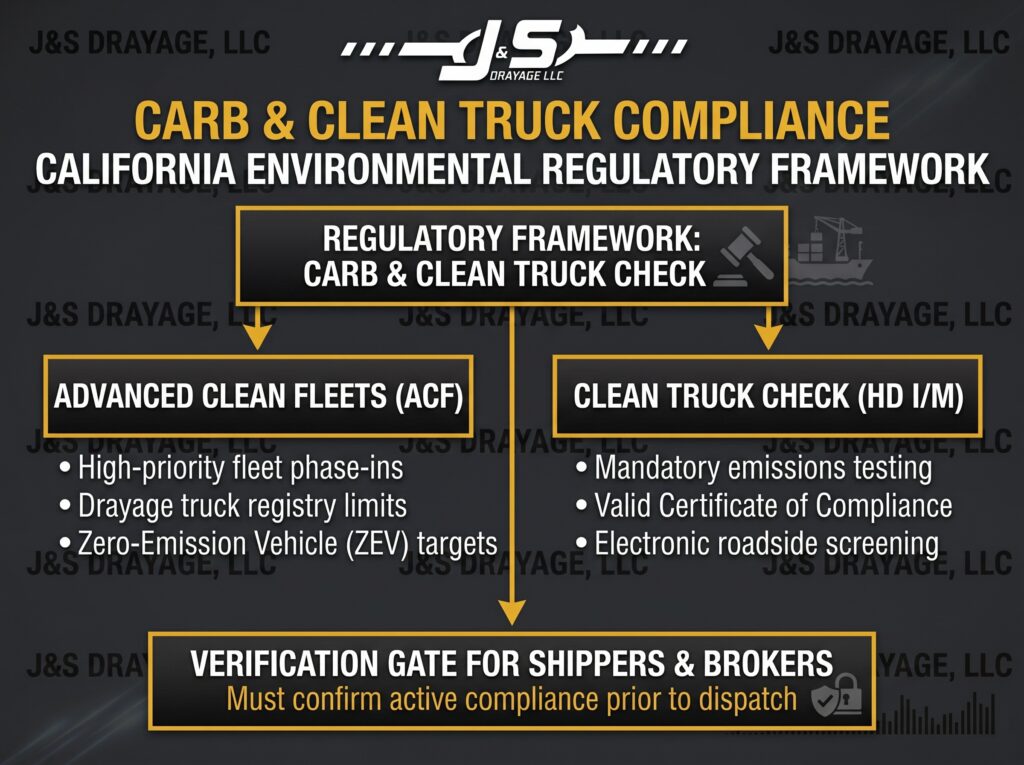
The Clean Truck Check (Heavy-Duty Inspection and Maintenance)
The Clean Truck Check applies to almost all diesel and alternative-fuel commercial vehicles with a gross vehicle weight rating (GVWR) greater than 14,000 pounds operating in California.
Key operational requirements include:
- Periodic Vehicle Testing: Heavy-duty trucks operating on California roadways must undergo regular periodic emissions testing and submit results to CARB’s centralized database.
- Certificate of Compliance: Compliant tractors receive an electronic compliance record. Vehicles failing to test or pay annual state fees are flagged, preventing annual DMV registration renewal and barring them from legal highway operation.
- Roadside Automated Screening: California uses automated Automated License Plate Readers (ALPR) and roadside emissions sensors on key logistics arteries—including Interstate 80, Interstate 5, and State Route 99—to instantly flag non-compliant equipment.
Advanced Clean Fleets (ACF) Hiring Entity Responsibilities
Under ACF rules, the regulatory focus expands beyond the motor carrier. Any hiring entity—defined as a shipper, broker, or logistics intermediary who contracts for freight transport within California—must verify that the fleets they dispatch are listed as compliant in state registries. Contracting with unverified or barred carriers exposes hiring entities to joint regulatory penalties.
The Operational Risks of Booking Non-Compliant Fleets
Hiring an unverified carrier to save on linehaul costs often backfires into severe operational friction:
| Risk Category | What Happens Operationally | Commercial Impact |
| Port Gate Rejection | Truck rejected at Port of Oakland or terminal gates due to inactive status. | Demurrage penalties, deadhead charges, missed vessel cutoffs. |
| Roadside Out-of-Service | Highway patrol or CARB field inspectors pull uncertified vehicles out of service during transit. | Stranded cargo, emergency cross-dock fees, critical delivery delays. |
| Hiring Entity Liability | State audits review freight contracts and bills of lading. | Substantial civil penalties assessed against brokers and shippers. |
| Customer Brand Risk | Disrupted assembly lines or stockouts at receiving distribution centers. | Retailer chargebacks (MABD/OTIF failure), lost vendor contracts. |
How Shippers and Brokers Can Audit California Dry Van Carriers
Before dispatching a single truckload across Northern California or into long-haul interstate lanes, implement a standardized carrier audit protocol.
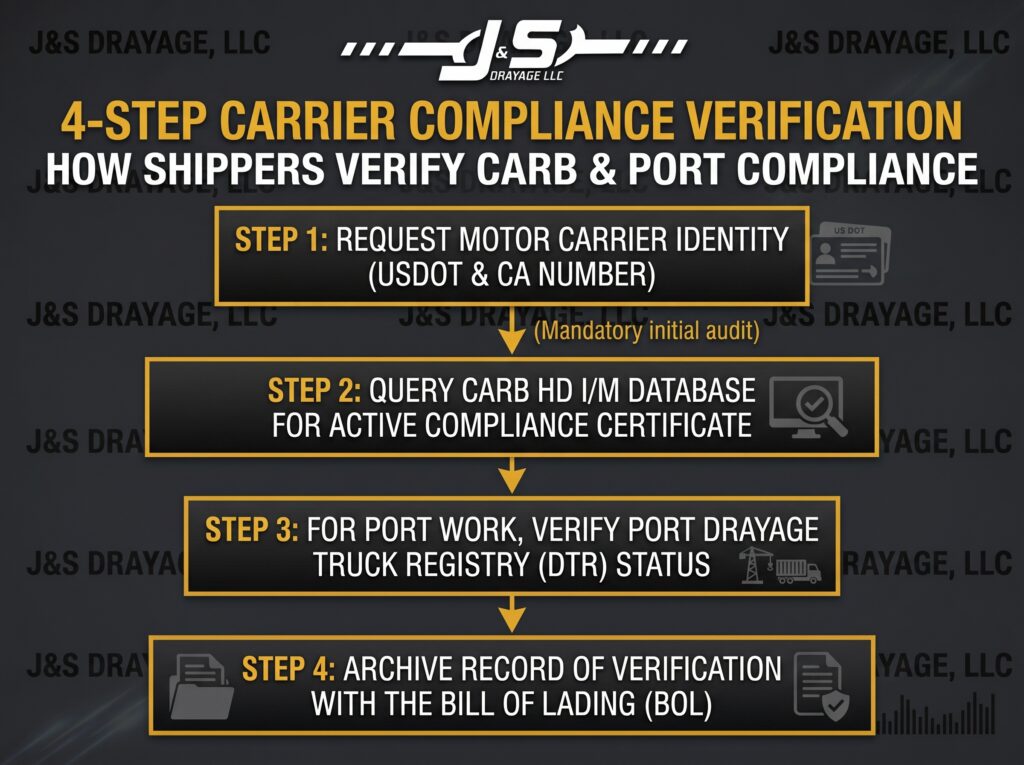
Step 1: Obtain Tractor VIN and License Plate Data
Do not rely exclusively on an active motor carrier (MC) safety authority. Demand tractor-specific Vehicle Identification Numbers (VINs) and state license plate information for every assigned power unit.
Step 2: Check the CARB Clean Truck Check Database
Cross-reference carrier power units against the CARB Heavy-Duty Inspection and Maintenance (HD I/M) database. Confirm that each tractor assigned to your lane holds a current, unexpired Certificate of Compliance.
Step 3: Check Drayage Truck Registry (DTR) for Port & Intermodal Moves
If your freight originates at or delivers to ocean docks like the Port of Oakland or local rail ramps, verify that the tractor is actively cleared in the CARB Drayage Truck Registry. Tractors not actively registered will be stopped at terminal gate cameras.
Step 4: Archive Proof of Audit
Maintain a digital record of the carrier’s compliance verification attached to the rate confirmation and Bill of Lading (BOL). California mandates that brokers and shippers retain records proving they verified carrier status for every load hauled within state borders.
Operational Advantages of Working with Asset-Backed Fleets
Brokerage spot boards and load boards carry increased compliance risk in California. When loads are double-brokered or handed off to unverified owner-operators, shippers lose direct line-of-sight on equipment compliance.
Partnering directly with an established, asset-backed carrier removes this guesswork. Dedicated carriers manage and maintain their own equipment, performing required periodic emissions testing, running routine maintenance cycles, and keeping certificates current.
Furthermore, integrating compliant dry van trucking with regional staging reduces transit friction. By coordinating with a secure California warehouse facility near major transport arteries, shippers can pull ocean containers directly from terminal docks, transload cargo into compliant 53-foot dry vans, and dispatch regional or long-haul truckloads without equipment-compliance delays.
Reliable, Fully Compliant Regional and Long-Haul Capacity
At J&S Drayage, we understand that supply chain stability requires complete regulatory discipline. Operating across Northern California and interstate corridors into Texas, our company-owned equipment is fully maintained to meet strict operational and environmental standards.
Our comprehensive transportation and warehousing solutions provide:
- Port of Oakland Integration: Dedicated Port of Oakland drayage services operating compliant trucks cleared for immediate marine terminal entry.
- Secured Staging in Livermore: A 32,000 sq. ft. secured warehousing facility located at 7650 Marathon Dr Ste N, Livermore, CA—less than an hour from the Port of Oakland—featuring 24/7 security cameras, yard storage, and fast transloading.
- Regional & Long-Haul Reach: Dependable dry van transportation services providing seamless freight movement throughout California and direct cross-country corridors to Dallas and Houston.