

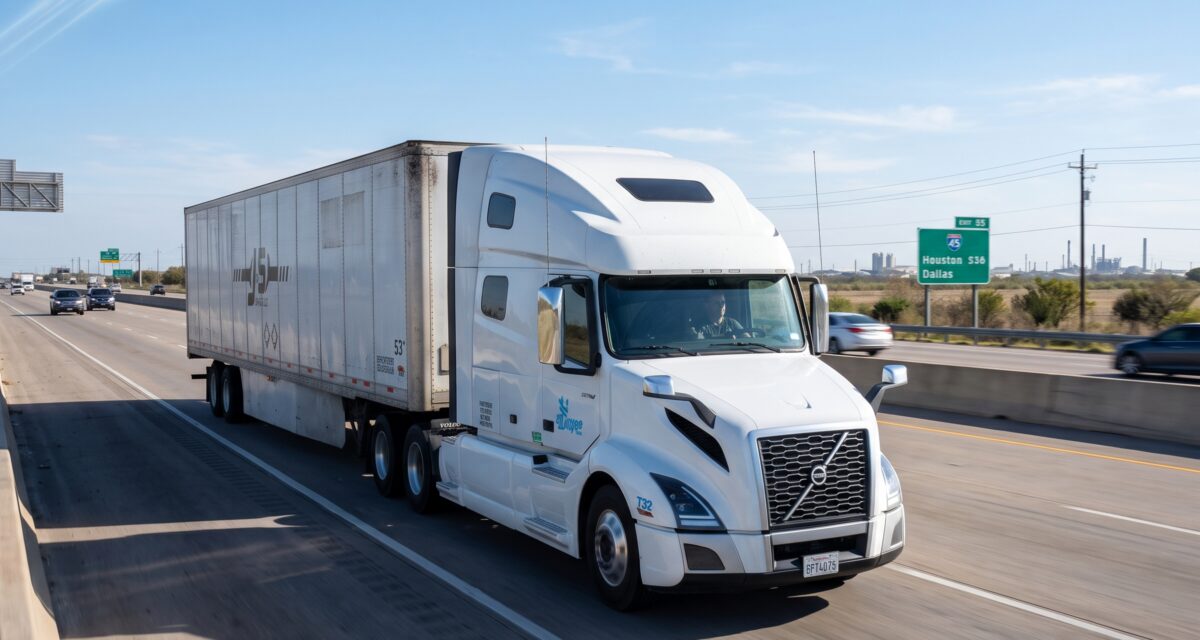
For manufacturing facilities and distribution centers operating in Texas, shipping goods between metropolitan centers requires balancing transportation spend against delivery predictability. Moving partial or full pallet orders between Dallas-Fort Worth, Houston, San Antonio, and Austin constantly forces a choice: consolidate shipments through an LTL network or secure dedicated Full Truckload (FTL) dry van capacity.
While LTL appears economical on paper for small consignments, scaling order volumes change the equation. Rehandling damage, accessorial fees, unpredictable transit windows, and linear-foot surcharges quickly erode anticipated savings.
Understanding when freight reaches the operational tipping point makes it clear when securing dedicated capacity via dryvan regional longhaul in Texas delivers a lower landed cost per unit and protects customer service commitments.
The Operational Mechanics: Network Freight vs. Point-to-Point Truckload
The fundamental difference between LTL and dedicated FTL dry van shipping lies in how cargo physically travels from shipper to receiver.
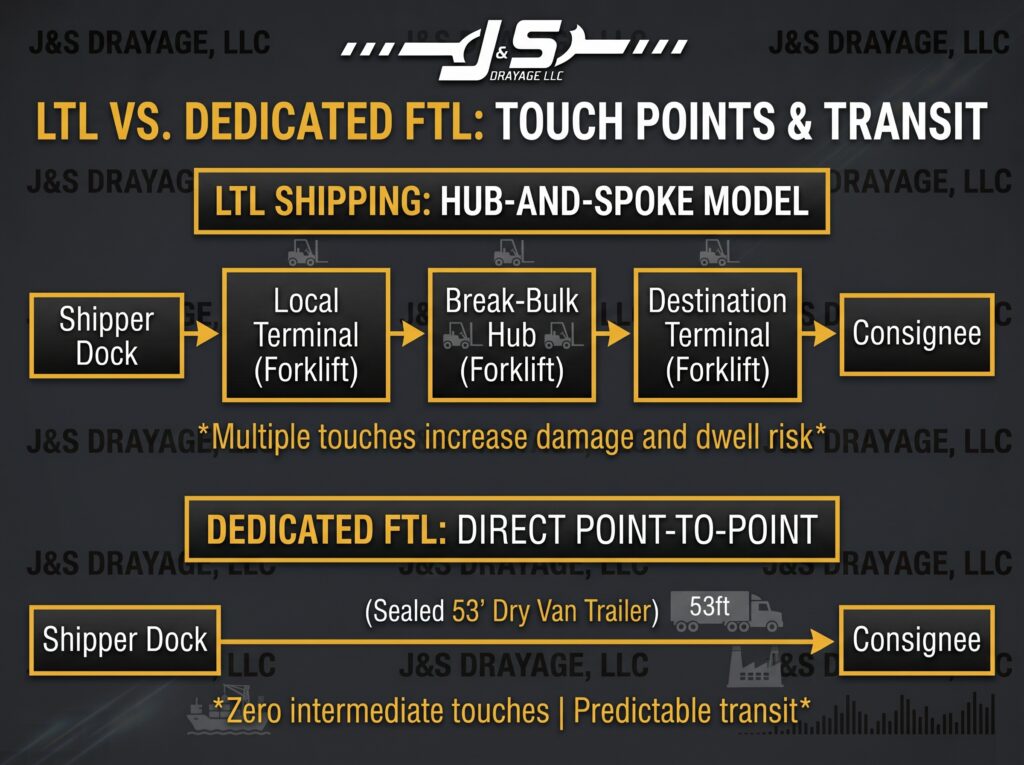
The LTL Model: Hub-and-Spoke Consolidation
Less-Than-Truckload carriers group partial shipments from dozens of shippers onto a single trailer. Freight moves through a series of regional cross-docks and break-bulk facilities.
- Every transition involves unloading, sorting across active dock floors, and reloading via forklift.
- Transit times are estimated, not guaranteed, as drivers manage multiple pickup and delivery appointments along local routes.
- Pricing depends on freight class (NMFC code), density, linear-foot rules, and dynamic terminal capacity.
The FTL Model: Dedicated Point-to-Point Linehaul
Full Truckload utilizes the exclusive capacity of a 53-foot dry van trailer dedicated solely to your shipment.
- Once loaded and sealed at the shipper’s facility, the trailer runs directly to the receiver without touching intermediate docks.
- Delivery windows are locked, allowing receivers to plan labor and dock door allocations accurately.
- Pricing is based on a flat linehaul rate per lane plus a standard fuel surcharge, regardless of the cargo’s commercial classification.
Cost-Benefit Comparison: FTL vs. LTL for Texas Shippers
Evaluating capacity options requires comparing operational friction points alongside base linehaul rates.
| Operational Factor | LTL Freight Network | Dedicated FTL Dry Van |
| Pallet Threshold | 1 to 6 standard pallets (Economical zone) | 8 to 10+ pallets (FTL financial tipping point) |
| Handling Risk | High (Forklift touches at 2 to 4 cross-docks) | None (Doors sealed at origin, opened at destination) |
| Transit Predictability | Variable (Subject to hub dwell and delivery routes) | Direct (Typically 3.5 to 5 hours on intra-Texas lanes) |
| Accessorial Exposure | High (Detention, liftgate, reweigh, reclass fees) | Low (Transparent pre-negotiated linehaul terms) |
| Equipment Control | No control over co-loaded neighboring freight | Clean, dedicated 53′ equipment outfitted to spec |
The Financial Tipping Point: When Dedicated FTL Outperforms LTL
A common mistake among growing mid-sized manufacturers is staying in LTL networks long after shipment volumes warrant truckload capacity.
1. The Pallet-Count and Density Rule (The 8–10 Pallet Threshold)
As a general rule across major Texas lanes like Dallas to Houston along Interstate 45, shipments reaching 8 to 10 standard 48×48 pallets (or occupying more than 16 to 20 linear feet of trailer space) approach rate parity with dedicated dry van spot rates.
LTL carriers enforce strict “linear foot rules.” When a shipment occupies excessive floor space, carriers re-rate the load with substantial cubic-capacity penalties. Booking a dedicated 53-foot trailer provides up to 26 floor pallet spaces (or up to 52 double-stacked pallets, weight permitting) at a single predictable price.
2. Eliminating Hidden Accessorial Surcharges
Base LTL quotes often diverge from final invoices due to post-delivery adjustments:
- Reweigh and Reclassification Fees: Dimensional scanners at LTL terminals trigger automatic penalties if pallet density shifts slightly.
- Driver Detention & Appointment Fees: Rigid delivery schedules can incur extra fees if the receiver’s dock encounters a backup.
- Limited Access Fees: Industrial parks lacking traditional dock heights or requiring liftgates incur separate line-item surcharges.
Dedicated FTL operates on transparent lane rates, eliminating surprise back-end accessorial invoices.
3. Mitigating Freight Claims and Customer Chargebacks
High-value industrial products, precision machinery, and commercial packaged goods are vulnerable to puncture and crush damage when repeatedly handled by terminal forklifts. Furthermore, large retailers and distribution centers levy strict On-Time, In-Full (OTIF) and Must-Arrive-By-Date (MABD) chargebacks. A single missed delivery window caused by an LTL terminal backup can erase the profit margin on the entire order.
Texas Corridors: Leveraging Regional Logistics Dynamics
Moving freight across the Texas Triangle (Dallas-Fort Worth, Houston, San Antonio, Austin) presents unique geographical opportunities. Distances between these metropolitan centers average 200 to 300 miles—ideal for same-day regional turns.
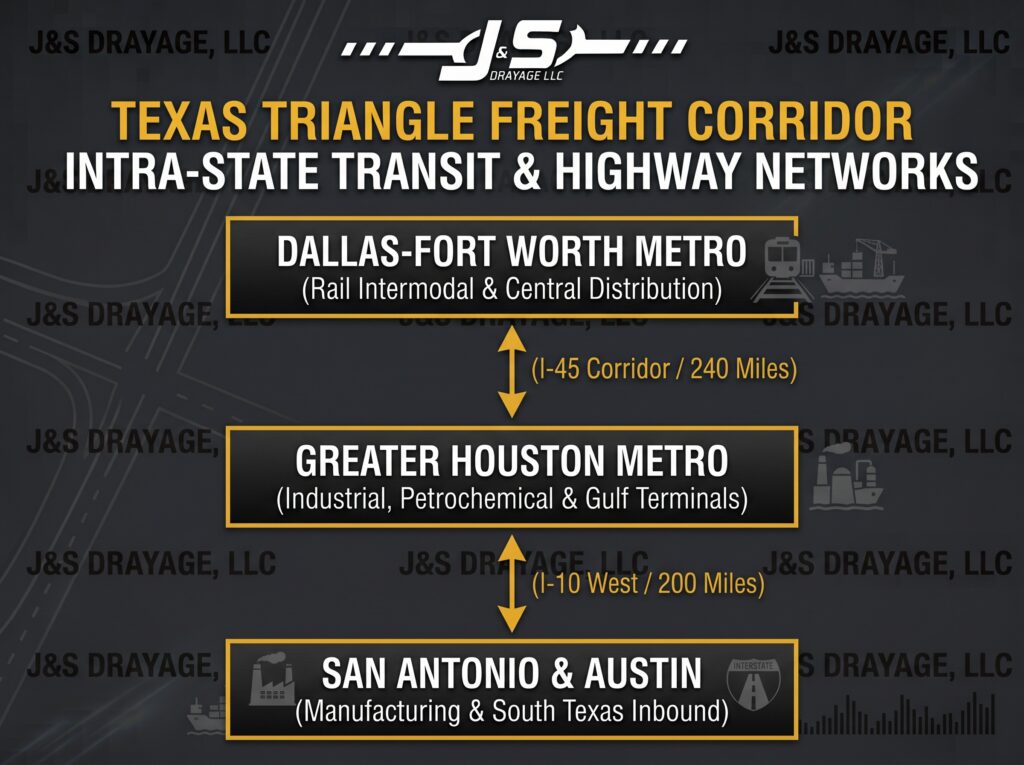
In an LTL network, an intra-Texas shipment moving from Dallas to Houston frequently takes two full business days due to overnight cross-dock sorting. Dedicated dry van transport completes this same transit in under 4.5 hours.
For multi-state supply chains, this regional speed proves invaluable. Shippers importing goods through West Coast ports like the Port of Oakland can transload ocean containers into 53-foot dry vans at a secure California warehouse facility. Once those goods move into North Texas, direct Texas dry van transportation services distribute finished loads to regional facilities in Houston and beyond without network delays.
Transitioning to Dedicated Dry Van Fleets: Operational Steps
When order velocity justifies shifting freight out of common LTL networks, implement these operational steps:
- Audit Pallet Consolidations: Group smaller multi-pallet customer orders traveling to the same regional hub into a single multi-drop full truckload.
- Review Freight Packaging and Cube Optimization: Transition from heavy LTL crate protection to efficient floor-loaded or pallet-secured layouts using trailer E-tracks and load bars.
- Establish Consistent Dispatch Schedules: Work with your transportation provider to set scheduled linehaul departures, allowing your shipping dock to stage orders efficiently.
- Partner with an Asset-Backed Carrier: Choose a carrier with local terminal infrastructure in both North Texas and the Gulf Coast to ensure reliable equipment availability and backhaul rate stability.
At J&S Drayage, we partner with manufacturers, distributors, and freight brokers to streamline regional and long-haul lanes across Texas. Whether managing high-volume runs along I-45 between Dallas and Houston or coordinating transloaded West Coast freight, our team provides reliable, responsive dry van capacity configured to your exact operational requirements.