

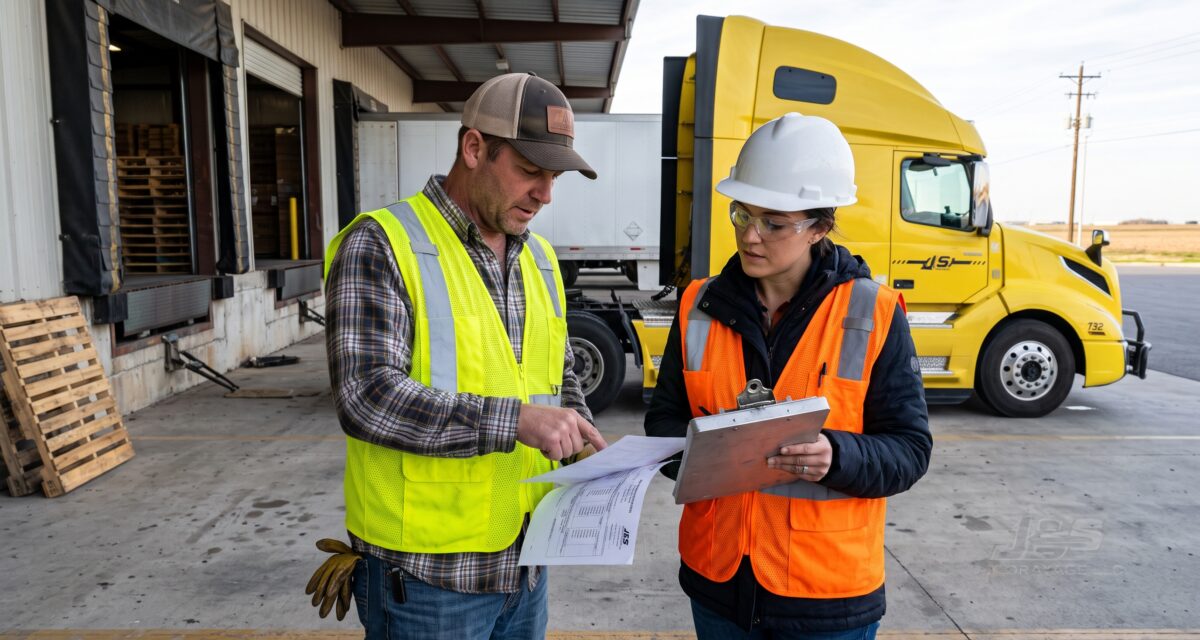
Texas moves massive freight volumes across a vast highway network connecting Gulf Coast seaports, border crossings, inland rail ramps, and major metropolitan distribution centers. However, tendering freight across Texas corridors requires paying close attention to regulatory boundaries.
Whether a shipment falls under state jurisdiction or federal oversight determines the operating authority, insurance minimums, driver qualifications, and weight limits required to move your cargo legally. Tendering freight to a carrier lacking the proper regulatory clearance risks roadside inspections, load impoundments, and missed delivery windows.
Understanding how state and federal rules apply to dryvan regional longhaul in Texas helps supply chain managers and freight brokers protect their shipments from avoidable compliance delays.
Intrastate vs. Interstate Commerce: Why Jurisdiction Matters
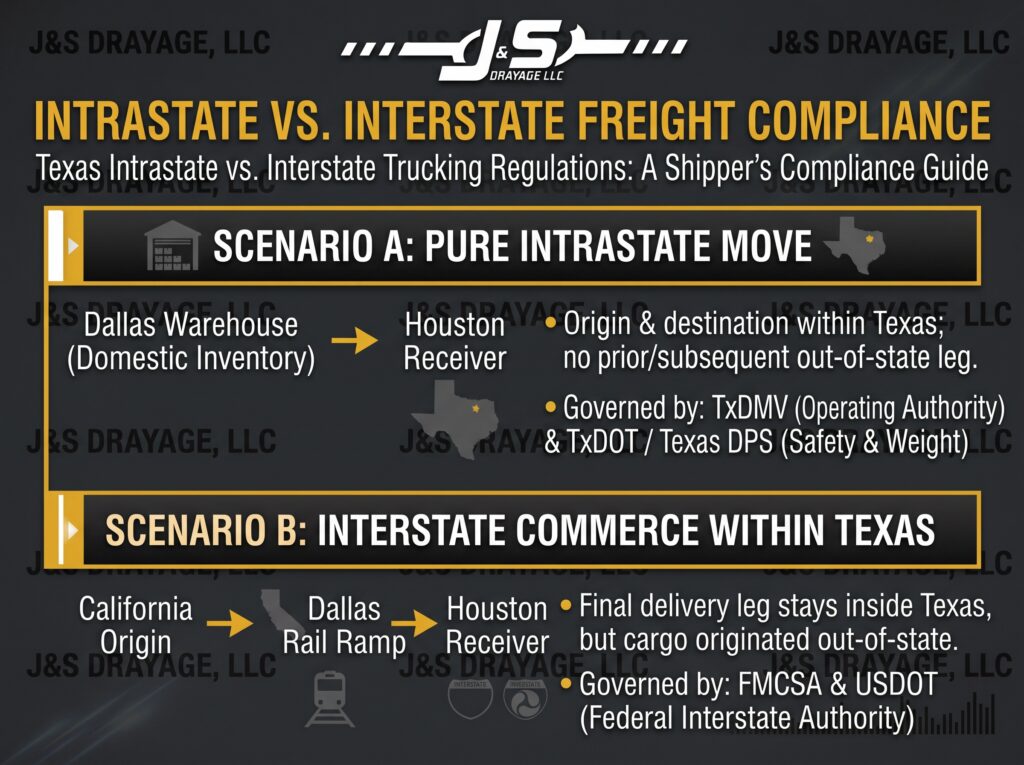
The regulatory agency governing a truckload is not determined solely by whether the truck crosses the Texas state border—it is determined by the essential character of the commerce and the shipper’s fixed intent at the time of shipment.
Intrastate Freight (TxDMV & Texas DPS Oversight)
A shipment is classified as intrastate when both the origin and final destination are located within Texas, and the freight has no continuous movement across state lines or international borders.
- Authority Required: Carriers must hold an active Texas Department of Motor Vehicles (TxDMV) Certificate Number.
- Safety & Enforcement: Regulated by the Texas Department of Public Safety (DPS) and the Texas Department of Transportation (TxDOT) under Texas Transportation Code standards.
Interstate Freight (FMCSA & USDOT Oversight)
A shipment is classified as interstate whenever freight crosses a state line or international border. Crucially, a shipment moving strictly between two Texas cities—such as a drayage move from a Dallas rail ramp to a Houston distribution center—still counts as interstate commerce if the cargo originated out of state (for example, transloaded in California) and is continuing toward its intended final destination.
- Authority Required: Carriers must hold active Federal Motor Carrier Safety Administration (FMCSA) Operating Authority (MC Number), a valid USDOT Number, and current Unified Carrier Registration (UCR).
Side-by-Side Comparison: Texas State vs. Federal Rules
| Regulatory Category | Texas Intrastate Standards | Federal Interstate Standards |
| Governing Agencies | TxDMV, TxDOT, Texas DPS | FMCSA, USDOT |
| Operating Authority | Active TxDMV Certificate | Active FMCSA MC Number & USDOT |
| Driver Minimum Age | 18 years old (for intrastate CDL) | 21 years old (mandatory for interstate) |
| Hours of Service (HOS) | Up to 12 hours driving after 8 consecutive hours off duty (Texas rule) | Up to 11 hours driving after 10 consecutive hours off duty (Federal rule) |
| Liability Insurance | Minimum $500,000 for general non-hazardous freight | Minimum $750,000 for general non-hazardous freight |
Note: When a carrier operates across both jurisdictions or hauls interstate-designated cargo within Texas, stricter federal FMCSA rules take precedence.
TxDOT Weight Limits and Permit Rules for Dry Van Loads
Overweight violations are one of the leading causes of roadside delays at Texas DPS weigh stations along Interstate 45, Interstate 35, and Interstate 10. While a standard 53-foot dry van trailer offers substantial cubic capacity, shippers must load pallets within strict legal axle and gross weight thresholds.
Standard Texas Legal Weight Limits (No Permit Required)
Under TxDOT guidelines, standard five-axle tractor-trailer combinations operating without an oversize/overweight permit must adhere to the following maximum limits:
- Gross Vehicle Weight (GVW): 80,000 pounds total (combining tractor, empty trailer, fuel, and cargo—leaving approximately 44,000 to 45,000 pounds for actual freight payload).
- Single Axle Limit: 20,000 pounds.
- Tandem Axle Limit: 34,000 pounds.
- Steering Axle: Generally limited by tire rating and manufacturer specs (typically 12,000 to 13,500 pounds).
Weight Distribution and Bridge Formula Compliance
Even if total cargo weight stays under 45,000 pounds, improper pallet placement inside a dry van can overload either the drive tandem or the rear trailer tandem.
- Shippers loading dense commodities (such as bottled beverages, paper rolls, or industrial hardware) must distribute weight evenly from nose to tail.
- Drivers must slide trailer tandems and verify axle weights at certified commercial scales before entering major Texas highway corridors.
Oversize/Overweight Permits
Standard enclosed dry vans rarely qualify for divisible-load overweight permits on interstate highways. While TxDMV issues specialized permits (such as the Annual Timber/Agricultural permit or specific border-zone permits), standard commercial dry van freight exceeding 80,000 lbs GVW must generally be reworked and split onto an additional trailer before transit.
Operational Best Practices for Vetting Texas Dry Van Carriers
Before tendering regional or long-haul loads to a carrier, logistics managers and freight brokers should run through a quick compliance verification:
- Match Authority to the Freight Leg: Confirm whether your shipment is pure intrastate or part of a continuous interstate supply chain, then verify active TxDMV and/or FMCSA authority accordingly.
- Verify Safety Ratings and Insurance: Check the carrier’s FMCSA SAFER profile to ensure active cargo liability coverage and satisfactory safety inspection scores.
- Confirm Trailer Specs and Scale Policies: Ensure the carrier operates well-maintained 53-foot dry vans and enforces mandatory scale checks for heavy palletized loads.
- Integrate Multi-State Capabilities: If your supply chain moves imported freight from West Coast ports into Texas, working with a provider that understands both California compliance and Texas regional rules eliminates handoff gaps.
Seamless Compliance Across Texas and Interstate Lanes
At J&S Drayage, we maintain active compliance across both state and federal jurisdictions so your freight moves without regulatory bottlenecks. Whether your shipments originate at West Coast ports or move directly between major Texas distribution hubs, our team manages the operational details from pickup to final delivery.
Our integrated capabilities include:
- Texas Dry Van Transportation: Dedicated Texas dry van services covering regional routes between Dallas and Houston as well as long-haul interstate corridors.
- Dallas Rail Freight & Drayage: Efficient intermodal container drayage connecting North Texas rail terminals to regional manufacturing and distribution facilities.
- West Coast Origin Support: Seamless coordination with our Port of Oakland drayage operations and our 32,000 sq. ft. secured Livermore warehouse facility in California for transloading ocean freight into 53-foot dry vans bound for Texas.