

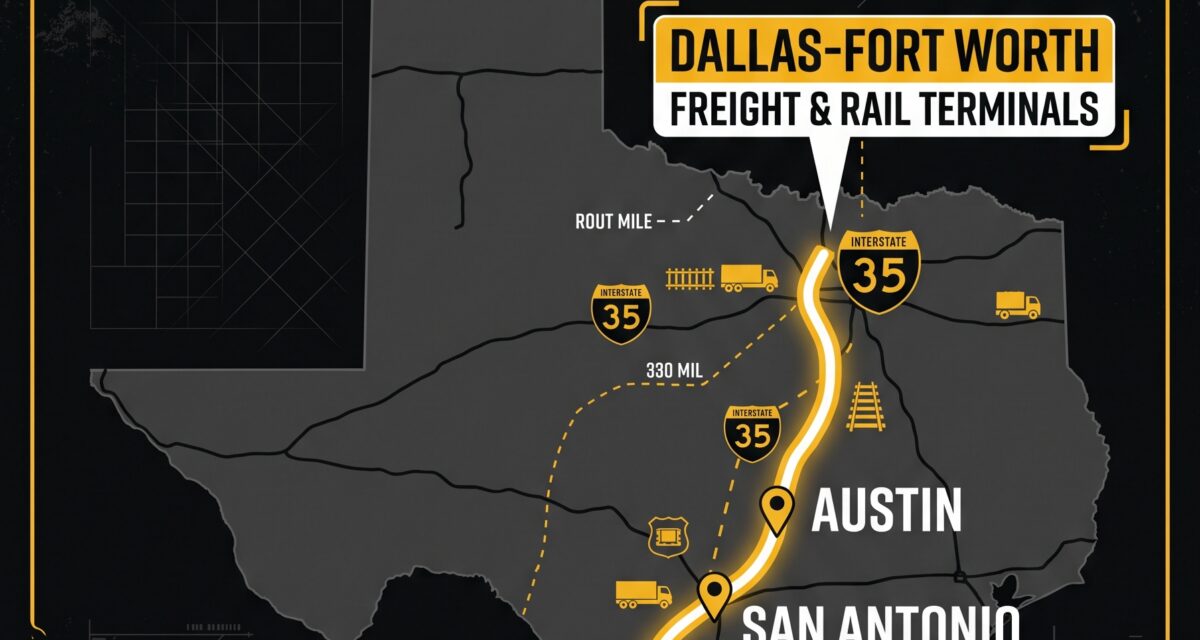
Nearshoring has shifted manufacturing volumes steadily toward northern Mexico, turning the Texas-Mexico border into one of North America’s busiest industrial gateways. For shippers and freight brokers, moving goods across the Rio Grande is only the first hurdle. Getting that freight reliably up Interstate 35 to distribution centers and intermodal ramps in the Dallas-Fort Worth (DFW) metroplex requires disciplined execution.
Securing consistent capacity for dryvan regional longhaul in Texas is central to keeping nearshored supply chains predictable. While the distance between Laredo and Dallas is roughly 435 miles—a single-day transit under standard federal Hours of Service (HOS) rules—border delays, customs holds, and misaligned staging can quickly turn a seven-hour drive into a multi-day bottleneck.
The Operational Reality of the Laredo-to-DFW Corridor
Port Laredo routinely ranks among the top U.S. trade gateways by dollar value, handling massive volumes of automotive components, electronics, industrial machinery, and consumer goods according to U.S. Census Bureau and Bureau of Transportation Statistics (BTS) trade data. Most of this southbound and northbound volume relies on 53-foot dry vans.
Once freight clears Mexican and U.S. customs at the World Trade Bridge or the Colombia Solidarity Bridge, it enters the domestic U.S. network. However, cross-border freight rarely moves seamlessly on a single tractor from a Mexican factory floor straight to a North Texas warehouse.
Common Friction Points on the Border-to-Dallas Lane
- Drayage and Transfer Handoffs: Most cross-border moves rely on specialized transfer carriers to pull trailers across the bridge into a Laredo yard before a domestic longhaul tractor hooks up. If the transfer driver is delayed at the border, the outbound regional driver risks losing their scheduled pickup window or running out of HOS.
- Customs and Inspection Holds: Secondary inspections by U.S. Customs and Border Protection (CBP) or agricultural checks can stall a trailer unexpectedly. Without clear communication between the customs broker, border yard, and domestic carrier, trucks sit idle accruing detention charges.
- I-35 Congestion and Construction: The I-35 corridor through San Antonio, Austin, and Waco experiences heavy commuter traffic and ongoing highway expansion. Departure timing out of Laredo directly impacts whether a driver hits peak urban congestion or arrives cleanly at a North Texas receiving dock.
- Imbalanced Equipment Pools: High northbound import volumes often create trailer imbalances. Shippers relying strictly on live-load/live-unload appointments frequently face tighter capacity and higher rates than those utilizing structured drop-and-hook programs.
Strategic Dry Van Routing for Nearshored Manufacturing Goods
Building resilience on the Laredo-to-Dallas lane requires treating cross-border staging and domestic linehaul as a single coordinated workflow rather than two disconnected transactions.
1. Synchronize Customs Clearance with Dispatch
Dispatching a domestic dry van tractor before a shipment has cleared U.S. customs is one of the fastest ways to burn driver hours and incur layover fees. Shippers should establish clear milestone triggers with their customs brokers and transportation providers:
- Confirm Automated Commercial Environment (ACE) manifest acceptance before scheduling the final linehaul hook.
- Verify whether the freight requires transloading in Laredo (moving cargo from a Mexican carrier’s trailer into a U.S.-domiciled 53-foot dry van) or if it is moving via a through-trailer interchange agreement.
2. Utilize Cross-Border Staging and Transloading Effectively
When manufacturing plants in Monterrey, Saltillo, or Queretaro ship high-frequency JIT (just-in-time) freight, staging near Laredo acts as a shock absorber. Consolidating partial loads or transloading freight onto domestic dry vans in Laredo protects your North Texas delivery schedules from border queue volatility. Once the trailer is loaded, sealed, and staged on the U.S. side, a regional carrier can execute a clean, predictable transit up I-35.
3. Plan Transit Around HOS and Receiving Windows
Under Federal Motor Carrier Safety Administration (FMCSA) regulations, property-carrying drivers are limited to 11 hours of driving within a 14-hour on-duty window following 10 consecutive hours off duty.
Because Laredo to DFW is approximately 435 miles, a driver picking up a pre-loaded trailer in Laredo early in the morning can legally complete the run to Dallas or Fort Worth within a single shift—provided they are not delayed at origin. Scheduling afternoon departures out of Laredo often forces drivers to stop overnight near Austin or Waco, pushing delivery to the following morning and reducing weekly tractor utilization.
| Operational Factor | Live-Load / Unplanned Dispatch | Staged / Pre-Cleared Regional Dispatch |
| Origin Dwell Time | High risk of 3–6+ hour delays waiting on bridge transfer | Minimal; tractor hooks to pre-cleared, staged trailer |
| I-35 Transit Predictability | Often hits peak Austin/San Antonio rush hours | Timed for off-peak corridor movement |
| HOS Utilization | Frequently requires a 10-hour rest break mid-route | Typically completed within a single 11-hour driving window |
| Detention Exposure | High exposure at both border yard and DFW receiver | Controlled through scheduled appointment windows |
Connecting Linehaul to North Texas Rail Terminals
For many importers and manufacturers, Dallas-Fort Worth is not the final destination—it is the inland intermodal launchpad for the Midwest, Southeast, and East Coast. Major Class I railroads operate high-volume intermodal terminals across the DFW metroplex, including hubs in Hutchins, Haslet (Alliance), and Mesquite.
Integrating dryvan regional longhaul in Texas with Dallas rail freight and drayage services gives shippers multiple options for onward distribution:
- Domestic Container Conversion: Freight moving north from Laredo in 53-foot dry vans can be transloaded into 53-foot domestic intermodal containers in DFW for cost-effective rail transit to Chicago, Atlanta, or the Northeast.
- Direct Terminal Coordination: Working with a carrier experienced in both Texas dry van trucking and Dallas rail operations ensures drivers understand terminal gate procedures, reservation systems, and chassis availability—preventing missed rail cutoffs.
What to Look for in a Texas Regional Dry Van Partner
When evaluating carriers or logistics providers to manage freight between the Texas border and North Texas, logistics managers should look beyond spot-market linehaul rates and verify operational alignment:
- Corridor Familiarity: Does the carrier regularly run the I-35 corridor between Laredo and DFW, and do they understand local staging yards and receiver requirements?
- Communication and Visibility: Can their dispatch team provide proactive updates from trailer hookup in South Texas through proof of delivery in North Texas?
- Flexible Service Capabilities: Can the provider support both point-to-point Texas dry van transportation and local Dallas rail drayage if your routing strategy shifts between over-the-road and intermodal?
- Safety and Compliance Standards: Verify active USDOT authority, FMCSA safety ratings, and cargo insurance coverage appropriate for high-value manufactured goods.
Partnering with J&S Drayage LLC for Texas Freight
At J&S Drayage LLC, we work directly with shippers, manufacturers, and freight brokers to keep regional supply chains moving without unnecessary handoff delays. Alongside our core port drayage, dry van, and warehousing operations in California, our Texas division supports customers with dependable dry van transportation and Dallas rail freight services.
Whether you are moving nearshored components north from Laredo into North Texas distribution centers or coordinating regional dry van capacity to connect with DFW intermodal terminals, our team focuses on responsive communication, realistic scheduling, and practical execution.